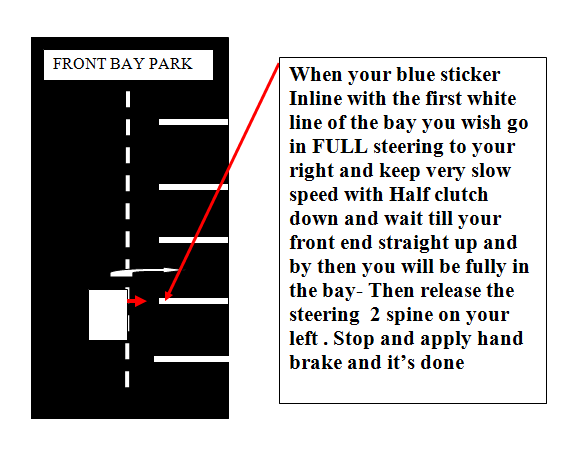
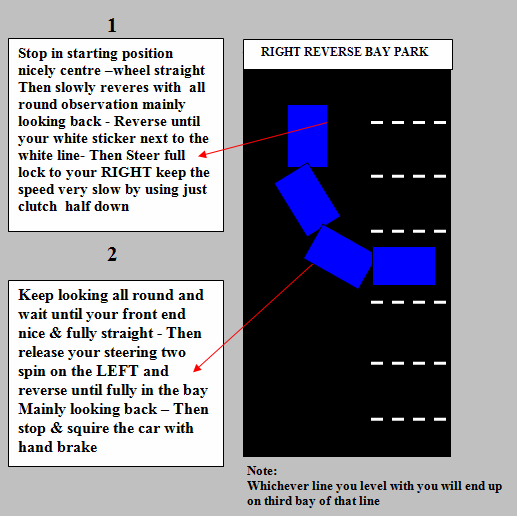
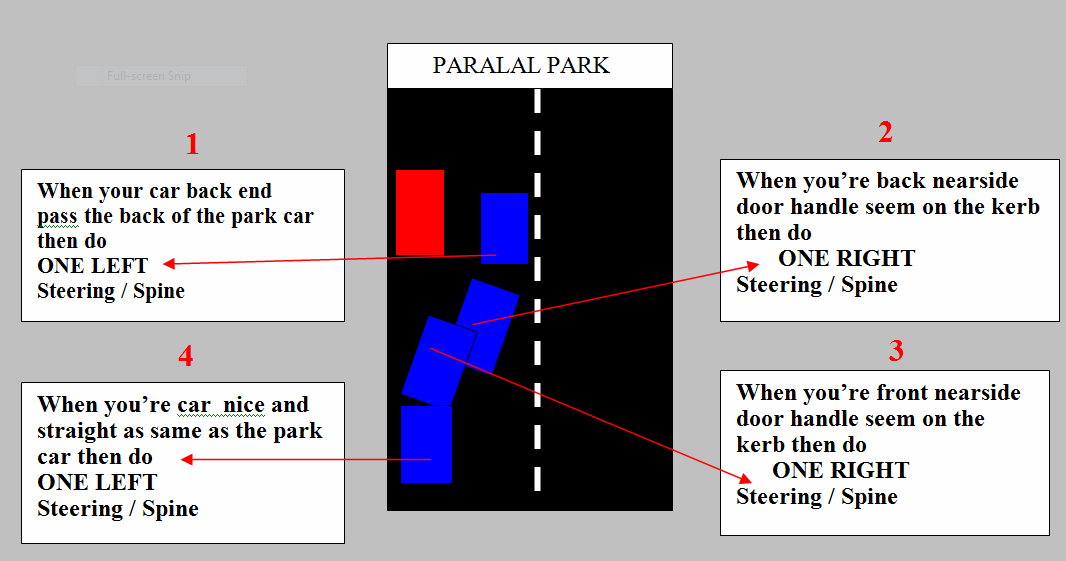
manoeuvers diagram
HOW TO AVOID FAILING DRIVING TEST
Junctions and crossroads
Must look well ahead and think in advance and make good use of MSPSL routine on correct time otherwise delaying it may result test fail because of inappropriate use of mirrors, signalling speed and position. Also you need to look out for any types of indication of what may be ahead such as Give way signs, roundabout signs or other road traffic signs. And always try to deal with any junction by, talk yourself through the approaching procedure well before you get there. Mirrors, signal, position, speed and look (MSPSL). Slow down in plenty of time. By approaching a junction or roundabout too fast, you simply have no time to see what is going on and often have to stop regardless of whether it is clear or not. By approaching slowly will enable you to go through the MSPSL procedure and give you plenty of time to see if the junction or roundabout is open or closed and avoid going over stop line while stopping since it may result fail.
OPEN = can easily see that it is safe to proceed without the need to stop
CLOSED = will need to slow down or stop the car due to lack of clear sigh.
Manoeuvres
Must avoid mounting the pavement, hitting the curb abruptly or not doing all-round observation and especially on reverse you must look back more frequently, The driving test will involve one manoeuvre may be an emergency stop also.
Parallel parking
Forward Bay parking
Reverses Bay parking
Straight reverses two car length
Following twenty minutes Sat-Nav instruction
The reverse bay parking only perform at test centre rest of other will be done on public road since the Manoeuvres are part of the driving test so you need to show the examiner that you can do it under full control with good observation and accuracy, and you can do that if you keep the speed as slow as possible and constant all round observation will help you to spot any hazard such as oncoming traffic or pedestrians.
Allowing adequate clearance
To avoid another common test fail, you must allowing adequate distance when passing parked cars or cyclists. If you are slightly too close to a cyclist or parked car, you will receive 1 minor. If the examiner deems you too close, then you will receive a serious or even a dangerous which results in a test fail. 3 or more of the same fault will also result in a test failure.
Moving off from a stationary position
The examiner will frequently ask you to park on the left. This is to ensure you do not mount the pavement, abruptly hit the curb and that you use correct observation and signalling if necessary. The examiner will then often simply ask you to move off again when you are ready. To avoid any common fault or confusion must try to take your time when preparing the car to move off and take good observation and analysing road traffic and avoid not giving signal or inappropriate indicating. However the best way to do that is by selecting 1st gear and put your hand on the hand brake ready to release. Look for any approaching vehicles out your front windscreen, look for any approaching from the rear by looking into your rear view mirror, then check your right side mirror and finally check the right blind spot.
If there is a vehicle approaching from in front and it is safe to move off, signal to the right, then move away. If a vehicle is approaching from the rear but you still have time to move off safely, then indicate and moving off. If a vehicle is approaching from the rear and you feel it is not safe to move off, then do not indicate but wait till the vehicle has passed and go through the whole procedure again, remember indicating front of others which cause the vehicle to alter their speed or course due to your indicating that may result a fail.
Use of speed
Due to lack of experience you may find hard to maintain correct speed, especially some road are now 20mph, yet the examiner will take you around various speed limit and will take you on narrow residential areas that will have parked vehicles and other hazards. Therefore you must adjust the cars speed appropriately and drive slower. These areas although quieter are often more hazardous due to oncoming vehicles that may be difficult to pass due to parked vehicles. Or small and closed junctions that are difficult to see. The examiner also take you to high speed A roads at 60 or 70mph and bring you back on then driving back into an urban environment which can be abruptly down to 30mph again. You must avoid driving too slowly which can be dangerous for vehicles behind as people tend to get impatient and try to over-take or same time must avoid too fast since you may not be able to keep up with lane desiplain and positioning or even losing control on bend.
Inappropriate use of mirrors or observation
Do not just miss mirror observation here and there during the test. normally the odd mirror missed will just result in a minor but if when essential to check the mirrors yet you miss it such as when moving off from a stationary position or making a left turn soon after you have just passed a cyclist or before changing any lanes.
Incorrect use of gears, clutch and steering
Try to hold the steering correctly since it allow more easy use such as ten-to-two position [of a clock] and when turning do not let the wheel straighten up by letting it spin by itself. This can potentially lead to a loss of control so it is best to use the push and pull technique
Incorrect use of gears can be for example to drive on a relatively straight road with few hazards in the incorrect gear. If it is a 30mph limit the gear should be the highest gear for that car that is most suitable for that speed. Often this is 4th or possibly 3rd gear. And remember when stopping at a junction try to use 1st gear [to avoid stall] when moving off unless the road is very downhill then you may use 2nd .And never try to keep depressing the clutch whilst making turns or depressing the clutch too early before stopping the car, this is called COASTING doing such action frequently may result test fail.
OUR WARNINGS & ADVICE
Since the JDT has reputation to hold, therefore it will not allow anyone use it’s vehicle to take test unless they are safe for the road and safe for the public.
Remember the driving test usually tends to find any weak points you may have. Therefore if you feel that you are still making some of the mistakes listed on this page, then keep practicing until it is perfected. It will be cheaper in the long run to have a few extra lessons and pass the driving test first time than to fail.
Some people manage to achieve test standard driving within 30-40 hours and test pass ability with in 40- 50 hours of training. However those who have slow learning capacity may take even more hours, in-fact it could take up to 80 -100 hours of trainings.
JDT advice not be stingy on taking extra lesson remember more you drive more experience you gain, which will defiantly result safe and economical in long run, specially nowadays the insurance for new driver is sky high, and the last thing anyone want is to pay more higher insurance due to accidents.
DRIVING TEST REPORT EXPLAINED
Listed below is a list of all the criteria you will be examined on during your practical driving test. Some criteria may vary according to the vehicle category you are taking a test in.
1(a) Eyesight Test
The start of the test will involve the examiner asking you to read a vehicles registration number. If you require glasses or contact lenses for reading, they must be worn for this test and whenever you drive.
1(b) Highway Code / Safety
For specialist vehicle tests that didn't require you having to take a separate theory test, you will have been asked questions on the Highway Code and other motoring matters related to your speciality. You will have also been asked to identify some traffic signs. If you have already passed a theory test you will not have been asked Highway Code questions at the practical test stage, but you should still have a thorough knowledge of it. Safety questions (if applicable) – you should know the location of, and be able to operate, safety components such as fire extinguisher, fuel cut-off switch and emergency door.
2 Controlled stop
The examiner will be assessing your ability and skill in bringing your vehicle to a stop safely, promptly and under full control and avoiding locking the wheels. In the event of wet weather, it can take twice as long to stop safely.
3, 4 and 5 Reverse exercises
You will need to display the ability to control the vehicle safely whilst reversing round a corner, reverse parallel parking or bay parking. You must take good effective all round observation throughout the manoeuvre and show consideration to other road users.
6 Turn in the road
The examiner will be look for a high level of car control, keeping the car slow and accuracy to not touch curbs. The turn in the road manoeuvre should be carried out with due regard for other road users and pedestrians.
7 Vehicle checks
You will need to display to the examiner a basic but essential level of safety checks applicable to your vehicle. This can include fluid level locations and levels, lighting and safety tyre checks. See Show Me Tell Me questions and answers for further information.
10 Vehicle and trailer combinations
You will need to demonstrate the skills necessary when uncoupling and recoupling your vehicle, driving the towing vehicle to a designated position prior to re-coupling safely.
11 Precautions
Before you start the engine make sure that you are comfortably seated and all controls can be safely operated.
12 Control
This section covers, where appropriate, the safe and controlled use of accelerator, clutch, gears, foot brake, parking brake, and steering. Additional specific control elements apply to the drivers of different vehicle categories. Always try and use the vehicle controls as smoothly as possible. This means less wear and tear on your vehicle and a smoother ride for your passengers. Make proper use of your accelerator and clutch to make a smooth start. Always depress the clutch just before you stop. Select the correct gear to match the road and traffic conditions. Change gear in good time but not too soon before a hazard. Do not allow the vehicle to coast by running on in neutral or with the clutch depressed. There should be no need to look down at the gear lever when changing gear. Use the foot brake smoothly and progressively. Brake in plenty of time for any hazard. Make full use of the parking brake whenever it would help you to prevent the vehicle rolling backwards or forwards, and if you are parking. Steer the vehicle as smoothly as possible. Avoid harsh steering, or steering too early or too late as it may cause you to hit the kerb or swing out towards another road user. If you are riding a motorcycle slowly, maintain a straight line and do not allow the machine to wobble towards other vehicles.
13 Move off
You will need to demonstrate your ability to move off smoothly and safely on the level, on a gradient and at an angle taking the correct precautionary observations.
14 Use of mirrors
Use all the mirrors fitted to your vehicle safely and effectively. You must always check carefully before signalling, changing direction or changing speed. You should demonstrate you can use the mirrors signal-manoeuvre (MSM) routine effectively.
15 Signals
You must signal clearly to let others know what you intend to do. You should only use the signals shown in the Highway Code if it would help other road users (including pedestrians).Always signal in good time and ensure that the signal has been cancelled after the manoeuvre has been completed. Do not beckon to pedestrians to cross the road.
16 Clearance / obstructions
Allow plenty of room to pass stationary vehicles, obstructions and be prepared to slow down or stop. A door may open, a child may run out or a vehicle may pull out without warning.
17 Response to signs/signals
You should understand and be able to react to all traffic signs and road markings. You must act correctly at traffic lights, and check that the road is clear before proceeding when the green light shows. Obey signals given by police officers, traffic wardens and school crossing patrols. Look out for signals given by other road users, including people in charge of animals, and be ready to act accordingly.
18 Use of speed
You should make safe, reasonable progress along the road bearing in mind the road, traffic and weather conditions and the road signs and speed limits. Make sure that you can stop safely, well within the distance you can see to be clear. Do not speed. Remember, as a new driver, your licence will be revoked if you get six or more penalty points during the first two years, and you will have to retake and pass both theory and practical tests.
19 Following distance
Always keep a safe distance between yourself and other vehicles. Remember, on wet or slippery roads it takes much longer to stop. When you stop in traffic queues leave sufficient space to pull out if the vehicle in front has problems.
20 Maintain progress
In order to pass your test you must show that you can drive at a realistic speed appropriate to the road and traffic conditions. You should approach all hazards at a safe, controlled speed, without being over cautious or interfering with the progress of other traffic. Always be ready to move away from junctions as soon
as it is safe and correct to do so. Driving excessively slowly can create dangers for yourself and other drivers.
21 Junctions (including roundabouts)
You should be able to judge the correct speed of approach so that you can enter a junction safely and stop if necessary. Position your vehicle correctly. Use the correct lane. If you are turning right, keep as near to the centre of the road as is safe. Avoid cutting the corner when turning right. If turning left, keep over to the left and do not swing out. Watch out for cyclists and motorcyclists coming up on your left and pedestrians who are crossing. You must take effective observation before moving into a junction and make sure it is safe before proceeding.
22 Judgement
Only overtake when it is safe to do so. Allow enough room when you are overtaking another vehicle. Cyclists and motorcyclists need as much space as other vehicles because they can wobble or swerve suddenly. Do not cut in too quickly after overtaking. Take care when the width of the road is restricted or when the road narrows. If there is an obstruction on your side or not enough room for two vehicles to pass safely, be prepared to wait and let the approaching vehicles through. When you turn right across the path of an approaching vehicle, make sure you can do so safely. Other vehicles should not have to stop, slow down or swerve to allow you to complete your turn.
23 Positioning
You should position the vehicle sensibly, normally well to the left. Keep clear of parked vehicles and position correctly for the direction that you intend to take. Where lanes are marked, keep to the middle of the lane and avoid straddling lane markings. Do not change lanes unnecessarily.
24 Pedestrian crossings
You should be able to recognise the different types of pedestrian crossing and show courtesy and consideration towards pedestrians. At all crossings you should slow down and stop if there is anyone on the crossing. At zebra crossings you should slow down and be prepared to stop if there is anyone waiting to cross. Give way to any pedestrians on a pelican crossing when the amber lights are flashing. You should give way to cyclists as well as pedestrians on a toucan crossing and act correctly at puffin crossings.
25 Position / normal stops
Choose a safe, legal and convenient place to stop, close to the edge of the road, where you will not obstruct the road and create a hazard. You should know how and where to stop without causing danger to other road users.
26 Awareness / planning
You must be aware of other road users at all times. You should always think and plan ahead so you can judge what other road users are going to do, predict how their actions will affect you and react in good time. Anticipate road and traffic conditions, and act in good time, rather than reacting to them at the last moment. Take particular care to consider the actions of the more vulnerable groups of road users such as pedestrians, cyclists, motorcyclists and horse riders.
27 Ancillary controls
You should understand the function of all the controls and switches, especially those that have a bearing on road safety. These include indicators, lights, windscreen wipers, demisters and heaters. You should be able to find these controls and operate them correctly when necessary, without looking down.